You’ve found the right car, the price looks right and the dates are available. At pick-up, however, you may discover that your debit card isn’t accepted for the deposit, that a different age limit applies, or that your driving licence needs an additional document.
Sync helps drivers search for available cars in Greece, but the requirements of each booking need to be checked before you pay.
Quick answer: what you need to rent a car
Before confirming your booking, follow these steps:
- Check that you meet the minimum age and the required number of years holding a licence.
- Bring an original, valid driving licence that is accepted in Greece.
- Bring an ID card or passport with the same details given in the booking.
- Confirm which type of card is accepted for payment and for the deposit.
- Check the deposit amount and whether it will be blocked or paid.
- Read the insurance cover, the excess and the main exclusions.
- Confirm the location, time, fuel, mileage, additional drivers and cancellation policy.
- Photograph the vehicle and check the rental agreement before you leave the pick-up point.
What documents you need to rent a car
At most pick-ups you’ll be asked for three basic things: a driving licence, an ID card or passport, and an accepted card in the main driver’s name. You’ll also need the booking confirmation, either on your phone or printed.
Don’t rely on a photo of your licence. The rental provider usually needs to see the original document and confirm that it is valid, legible and appropriate for the vehicle category. A digital version you use in everyday life doesn’t automatically mean it’s enough for a private rental contract.
The full names on the booking, the ID document and the card must match. A small difference in the Latin spelling can usually be explained, but a booking in someone else’s name creates a real problem. The main driver is the one who signs the contract and is often the one who must present the card.
Let’s use a specific example throughout this guide. Maria is 27, has held a Greek driving licence for four years and is planning five days on Naxos. She wants a small automatic car, pick-up at the port and payment by debit card. Her documents are sufficient as a starting point, but that doesn’t yet answer whether her card will be accepted, whether there is a deposit, or whether the car may be taken on a ferry.
Keep the confirmation, the terms, the payment receipt and the provider’s contact details in one folder or in a secure place on your phone. Bring the original documents too. Being organised like this saves time when pick-up is late in the evening or at a location without a regular office.
Which driving licence is accepted in Greece
A valid driving licence from a European Union country is generally recognised in the other EU countries, under the conditions explained on the EU’s official page on the recognition and validity of driving licences. The provider may also require you to have held the licence for a minimum period, often depending on the car category.
If your licence was issued outside the EU, check in writing whether an International Driving Permit is required alongside your national licence. The International Driving Permit doesn’t replace the original national document. It accompanies it and must be valid.
Don’t assume that a licence in Latin script is enough in every case. The issuing country, the international conventions that apply, the length of your stay and the provider’s policy can all affect acceptance. Send a photo showing the type of licence before you book, hiding any personal details that aren’t needed, and ask for clear confirmation.
Also check the expiry date. If your licence expires during the rental period, renew it before you travel. Loss certificates, temporary licences and renewal documents aren’t always treated like a regular licence.
In our example, Maria has a valid Greek category B licence, so she doesn’t need an International Driving Permit. She must, however, present the original. If she had left her licence at home and only showed a photo, the provider could refuse to hand over the car.
What age you need to be to rent a car
There is no single age limit that applies to every company, provider and vehicle in Greece. The limit is stated in the terms of the specific offer and may be combined with a requirement to have held a licence for one or more full years.
Younger drivers may face an additional charge, a higher excess or limited access to certain categories. A small city car may be available, while an SUV, convertible, luxury model or large van may require an older age and more driving experience.
The same applies to upper age limits. Not every provider applies them, but where they exist, additional documents or confirmation may be requested. Check the requirement for every driver, not just the person doing the search.
Maria, at 27 with four years of driving experience, most likely meets the terms for many small cars. The words “most likely” are crucial. She needs to open the terms for the specific vehicle rather than rely on general market practice.
Renting a car with a debit card or without a credit card
Paying for the booking and the deposit are two different transactions. A provider may accept a debit card for the online payment but require a credit card at pick-up to block the deposit.
Check four details: the accepted card type, the cardholder’s name, the available limit, and whether the transaction is a hold or an actual charge. Prepaid and digital cards may not be treated like a regular debit or credit card.
To rent without a credit card, look for an offer that explicitly states a debit card is accepted at pick-up. Ask whether this changes the deposit, the insurance cover or the vehicle category. A verbal assurance that isn’t linked to your specific booking is weak protection. Get the answer in writing.
Maria finds an available car on Naxos, but sees that the payment terms don’t clearly say whether her debit card is enough for the deposit. She shouldn’t complete the booking hoping it will be sorted out at the port. First, she confirms that the card is accepted, that it is in her own name and that it has enough balance for any hold.
Renting without any card is more limited and depends entirely on the provider. If cash payment is offered, ask how the deposit is covered and what receipt is issued. Don’t transfer money outside the agreed booking process without verified details of the other party.
How the deposit works when renting a car
The deposit covers possible obligations set out in the contract, such as damage up to the excess amount, fuel, late return, administration fees or lost equipment. It isn’t necessarily a final charge. Often an amount is blocked on the card and released after the vehicle has been returned and inspected.
Ask whether it is a pre-authorisation or an actual payment. Also ask when the release instruction is given and whether the time it takes to show in your account depends on your bank. Keep the return report until the process is complete.
The phrase “no deposit” needs care. It may mean that no amount is blocked, that the deposit is reduced because of additional cover, or that a different liability arrangement applies. Read what happens in case of damage, theft, wrong fuel, a lost key, and damage to the tyres or the underside.
The key questions before you pay are:
- What amount is blocked or charged?
- On which card, and in whose name?
- Which cases can be deducted from the deposit?
- When does the release start after the return?
- Is there a different deposit for a debit card or for a specific vehicle category?
For Maria, a low daily rate isn’t enough for a comparison. If one offer accepts her debit card on clear terms and the other requires a credit card she doesn’t have, the second isn’t a real option, however attractive it may look at first.
Insurance, excess and damage before pick-up
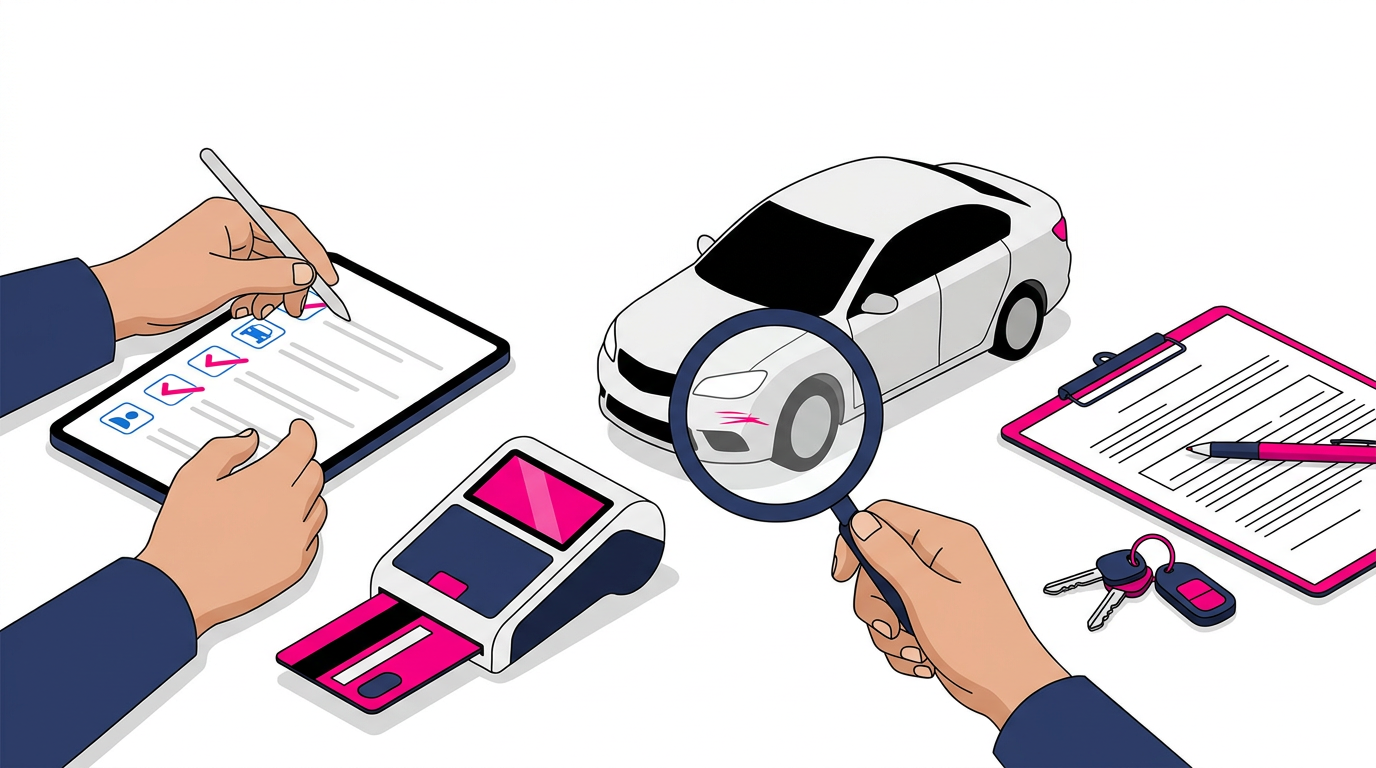
A mention of “insurance” doesn’t mean every incident is covered with no financial liability. Read what cover is included, what the excess is and which damage is excluded. The EU guidance on car rental and consumer rights stresses the importance of checking the terms, any extra charges and the condition of the vehicle.
Common points that need a separate read are tyres, wheel rims, glass, the underside, the roof, the interior, lost keys and misuse. Check whether the cover applies on dirt roads, during ferry crossings and when an additional person is driving.
At pick-up, walk all the way around the vehicle. Take photos and a short video in good light. Record scratches, dents, the windscreen, wheel rims, tyres, roof and interior. Photograph the fuel or charge gauge and the mileage.
Ask for every existing mark to be added to the handover form. If you’re told it’s “already in the system”, ask for a copy that shows it. Do the same check on return and get written confirmation when available.
On Naxos, Maria notices a scratch low on the rear bumper. The initial form doesn’t mention it. She photographs it, asks for it to be recorded before she takes the keys, and keeps the updated copy. This short delay is better than a dispute after she has left.
What you need to rent a car at an airport or on an island
At the airport, you need to know whether pick-up is at a desk inside the terminal, at an off-airport location with a shuttle, or with a representative at an agreed meeting point. Give your correct flight number. That way, if there’s a delay, the provider can link your late arrival to your flight — although this doesn’t cancel the terms for out-of-hours pick-up.
For the capital, you can check options separately at Athens Airport and in the wider Athens area. The distinction matters, because an offer in the city centre doesn’t automatically mean free delivery to the airport.
The same applies in Thessaloniki. Confirm the exact address, the opening hours, any shuttle arrangement and who to call after you’ve collected your luggage.
On the islands, distances may be short, but the practical restrictions are different. Ask whether the car is delivered to the port, the airport, your accommodation or an office. Door-to-door delivery doesn’t always mean you can return the car to a different location.
In particular, check:
- Whether the car may be taken on a ferry.
- Whether you can take the vehicle to another island or to mainland Greece.
- Which roads or dirt tracks are excluded from use and from cover.
- How roadside assistance works on that particular island.
- What happens if the ferry is cancelled and your return is delayed.
Maria picks up the car on Naxos and is considering a day trip by ferry. She doesn’t buy a ticket for the car before getting written permission. If taking it on a ferry is prohibited, the insurance cover may be affected and doing so may breach the contract.
How to choose the right car for Greece
The smallest and cheapest vehicle isn’t always the most suitable. Count your passengers and your actual luggage. Four adults with four large suitcases rarely fit comfortably in a small city car, even if it is listed as a five-seater.
For narrow villages and limited parking, a small model has a clear advantage. An SUV offers space and a higher driving position — not permission to use prohibited or rough roads. You can compare available SUV rentals, always checking the specific terms of each vehicle.
For a large family or group, a minivan may be more practical than two small cars. Check the licence category, the number of seat belts, the luggage space and any access or parking restrictions. For a commercial van, also consider the payload and the use the contract allows.
With electric cars, don’t look only at the stated range. Check the plug type, the cable, the charging infrastructure along your route and the charge level required on return. Sync’s page for electric cars for rent helps you narrow your search to the right category.
For convertibles and luxury models, expect stricter terms on age, card and deposit. Also check where the vehicle will be parked. A more expensive car left exposed on a narrow road next to a beach may add stress rather than comfort.
How searching and booking work on Sync
Doing it manually means opening lots of offers, comparing categories and checking the terms separately. Sync brings the search for available cars together, so you start from the destination and dates instead of looking for providers one by one.
First, you choose the place where you need the car. This can be a city, an island or a specific arrival point. In the example, Maria starts with Naxos instead of searching for a “car in Greece” in general.
Next, you enter the rental period. The right times matter, not just the dates. If your ferry arrives at 18:30, don’t choose a 16:00 pick-up unless something different has been agreed.
Then you look at the available vehicles and pick a category based on space, transmission and use. Maria narrows her choice to a small automatic, because she’ll be driving around villages and doesn’t need an SUV.
After that, you check the terms of that specific option. This is where the age, licence, card, deposit, insurance, fuel, mileage and delivery point need to be confirmed. The overall process is explained on the how Sync works page, but the final contract and the vehicle’s terms are what count.
Finally, you keep the confirmation and get in touch in good time about anything that isn’t clearly stated. In our case, Maria asks for a written answer about her debit card, delivery to the port and possibly taking the car on a ferry. That way she arrives at pick-up knowing what she needs to show and what has been agreed.
Sync takes away part of the searching. It doesn’t remove the need to read the offer. This approach is especially useful in the Greek market, where different local providers can have substantially different terms even in the same destination.
Common mistakes before renting a car
A last-minute booking usually limits the categories available and the time for clarifications. If it can’t be avoided, don’t skip checking your documents and card just to save a few minutes. Call before you head to the pick-up point.
A common mistake is comparing only the headline price. Your final choice should include everything you actually need: an additional driver, a child seat, a different return location, mileage limits and the insurance excess.
Another problem is not registering a second driver. If their name isn’t added to the contract, they may not be covered when they drive. Show their licence and ID at pick-up and pay any agreed charge.
Don’t sign a form with blank fields or details you don’t understand. Ask for an explanation of every amount and keep a copy. Check the number plate, fuel level, mileage, return time and recorded damage.
Finally, don’t assume the fuel policy is the same everywhere. “Full to full” requires returning the car with the same level, and it’s usually worth keeping your last fuel receipt. For an electric vehicle, an agreed charge level applies, not a petrol policy.
FAQ: what you need to rent a car
Can I rent a car with just my ID card?
No. Your ID card proves who you are, but it doesn’t prove you’re entitled to drive. You need a valid driving licence and, depending on the offer, an accepted card and a booking confirmation.
Can I rent a car without a credit card?
Yes, if the specific provider accepts a debit card or another method for payment and the deposit. Confirm it in writing before you pay, because a debit card being accepted online doesn’t guarantee it will be accepted at pick-up.
Can I rent a car without a deposit?
There are offers with a zero or reduced deposit, but the term must be stated clearly. Check whether it is tied to different insurance cover and what financial liability you keep in case of damage or a breach of the terms.
Do I need an International Driving Permit in Greece?
It depends on the country that issued your licence. EU licences are generally recognised within the EU. For a licence from a non-EU country, ask the provider to confirm whether you need an International Driving Permit alongside your original national licence.
Can someone else pay for the booking for me?
It may be possible for the prepayment, but the card for the deposit often has to belong to the main driver. Check the terms for online payment and for pick-up separately.
Am I allowed to take the rental car on a ferry?
Only if the provider and the contract allow it. Ask for written permission before you buy a ticket, as there may be geographical restrictions or different roadside assistance and insurance terms.
What should I do if my flight or ferry is delayed?
Let the provider know immediately and give them your flight number or sailing details. Don’t assume the vehicle will be held indefinitely. Ask for confirmation of the new time and of any out-of-hours pick-up.
What is the safest choice before I book?
Choose a vehicle whose terms clearly cover your age, licence and card. Confirm the deposit, insurance and delivery location in writing. If a key piece of information is missing, ask before you pay or choose another offer with clearer terms.