You find a car with a good daily rate, but the terms include words like CDW, excess, deposit and exclusions. If you don’t check them before you book, a scratch could cost you far more than the entire rental.
On Sync you can search for available cars, but choosing well doesn’t stop at the model and the price. You need to read what cover comes with that particular vehicle and how much financial liability remains with you.
Quick answer: what rental car insurance includes
To understand what is actually covered, go through it in this order:
- Confirm that third-party liability is included.
- Check whether damage to the rental vehicle itself is covered.
- Find the exact excess for damage and for theft.
- Read which add-on covers reduce the excess or bring it to zero.
- Identify the exclusions, such as tyres, glass, the underside and wrong fuel.
- Distinguish the insurance cover from the deposit blocked on your card.
- Compare the total cost, the pick-up terms and the procedure for reporting damage.
Basic insurance usually covers third-party liability and may limit your liability for damage or theft. It doesn’t automatically mean every incident is covered at no charge. The excess and the exclusions are what determine your real financial risk.
What basic rental car insurance includes
Every vehicle on the road legally must have the required third-party liability cover. This applies to bodily injury or property damage caused to third parties, in line with the policy and its applicable limits. The relevant European framework is set out in the Motor Insurance Directive.
Third-party liability doesn’t automatically pay for damage to the car you rented. For that, the term CDW is often used, meaning a limit on your liability for collision damage. In many contracts this isn’t a separate insurance policy that the driver buys, but a contractual limit on the amount the provider can ask the driver to pay.
The same applies to theft protection, which may be listed as TP. It limits your liability if the car is stolen, but it usually requires reporting to the police immediately, handing over the keys and following the safekeeping terms.
Don’t assume the abbreviations mean exactly the same thing at every company. Hertz, Sixt, Avis and smaller local providers may use similar terms for different limits, exclusions and procedures. Read the terms of your specific booking.
An example we’ll follow to the end
Maria is planning five days on Naxos and finds a small car with a base cost of €180. The offer includes third-party liability, a limit on liability for damage, and theft protection. The excess is €900.
The amounts in this example are hypothetical and are not a price list from Sync or any provider. But they let us see how Maria’s liability changes depending on the damage and the cover she chooses.
If she causes €600 of damage and the incident is covered, she may be charged up to €600. If the covered damage reaches €2,400, her contractual liability is capped at the €900 excess. This only applies as long as no term has been breached.
How the excess works in rental car insurance
The excess is the maximum amount the driver contributes for a covered incident, as defined in the contract. It isn’t an extra daily charge, and it doesn’t mean you will necessarily pay the full amount.
In Maria’s example, the excess is €900. If repairing covered damage costs €350, the charge shouldn’t automatically be €900. The actual cost will be assessed, together with any lawful and contractually agreed administration fees.
If, however, the damage is excluded from cover, the €900 cap may not apply. A torn tyre, damage to the underside from driving on an unsuitable road, or a lost key may be treated differently.
Also check whether there are separate excesses for damage and theft. A contract might, for example, set €900 for damage and €1,200 for theft. Don’t settle for the phrase “insurance included”.
Excess, deposit and charge are not the same thing
The deposit is an amount temporarily blocked as security. The excess is the potential maximum liability for a covered incident. The final charge is the amount actually billed after the incident has been assessed.
The three amounts may coincide, but they don’t have to. With a €900 excess, a provider may block €900 or a different amount, depending on the terms, the vehicle category and the payment method.
The EU guidance on car rentals points out that insurance options, charges and fuel terms should be checked before signing. Ask for the final contract and keep a copy.
How to work out the real cost of cover
A cheap base price isn’t always the most economical choice. Compare what you pay for the rental with the amount you’re willing and able to cover if something happens.
Let’s look at Maria’s options. The basic rental costs €180 and leaves a €900 excess. An optional cover costing €12 a day reduces the excess to €200. For five days, the total extra charge is €60 and the booking total becomes €240.
A second option costs €20 a day and reduces the excess to €0 for the damage it includes. The total extra charge is €100, so the booking comes to €280.
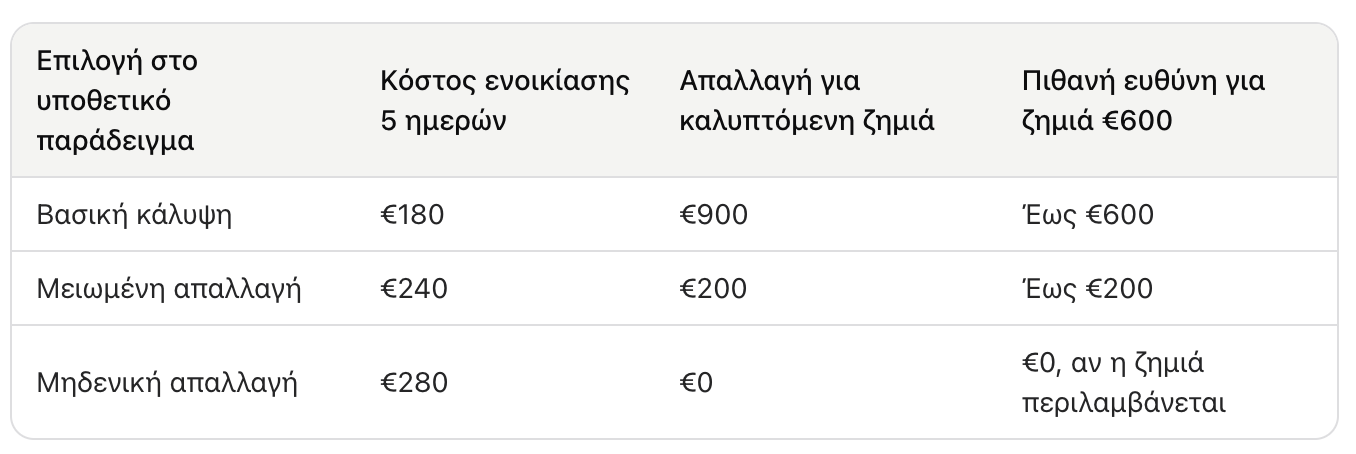
The more expensive option limits the risk further, but it isn’t necessarily right for everyone. If Maria can handle a possible €200 charge, the middle option offers a more controlled cost. If she doesn’t want any significant financial exposure, she’ll consider the zero excess and read its exclusions carefully.
For a rental of several days, first multiply the daily charge for the add-on cover by the number of days. Add any charges for delivery, a second driver, a child seat, the airport or a one-way return. Only then do you have a comparable total.
Which add-on covers are worth considering
Add-on options usually reduce the excess or extend protection to parts of the car that are left out of the basic cover. The name of a package, even if it includes the word “full”, isn’t enough.
Reduced or zero excess
This is usually the most meaningful upgrade. It reduces the amount you may have to pay for covered damage. Confirm whether the deposit is reduced as well, because this doesn’t always happen automatically.
Glass, tyres and underside
Glass and tyres are exposed to small but often expensive damage. On the islands, a drive to a beach may involve a dirt road, potholes or low rocks. That doesn’t mean all such damage is covered.
Maria wants to visit a beach on Naxos via an unpaved road. Even with add-on cover, she needs to check whether driving there is allowed. If the terms prohibit driving off the paved road network, tyre cover doesn’t override that prohibition.
Personal accident and personal belongings
Personal accident cover usually applies to the driver and passengers, with specific limits. Belongings cover may apply to luggage, but it often excludes cash, electronic devices or items left visible in the vehicle.
Before buying it, check whether you already have similar protection through travel insurance or another policy. Avoid paying twice for cover you already have — but don’t assume the limits and conditions are the same.
Roadside assistance
Basic roadside assistance may cover a mechanical breakdown not caused by the driver. Other incidents, such as keys locked in the car, a flat battery from lights left on, wrong fuel or a tyre change, may be charged.
Ask which number to call, whether assistance is available 24 hours a day and what procedure applies on an island. In remote areas, response times depend on whether a local garage is available.
What rental car insurance usually doesn’t include
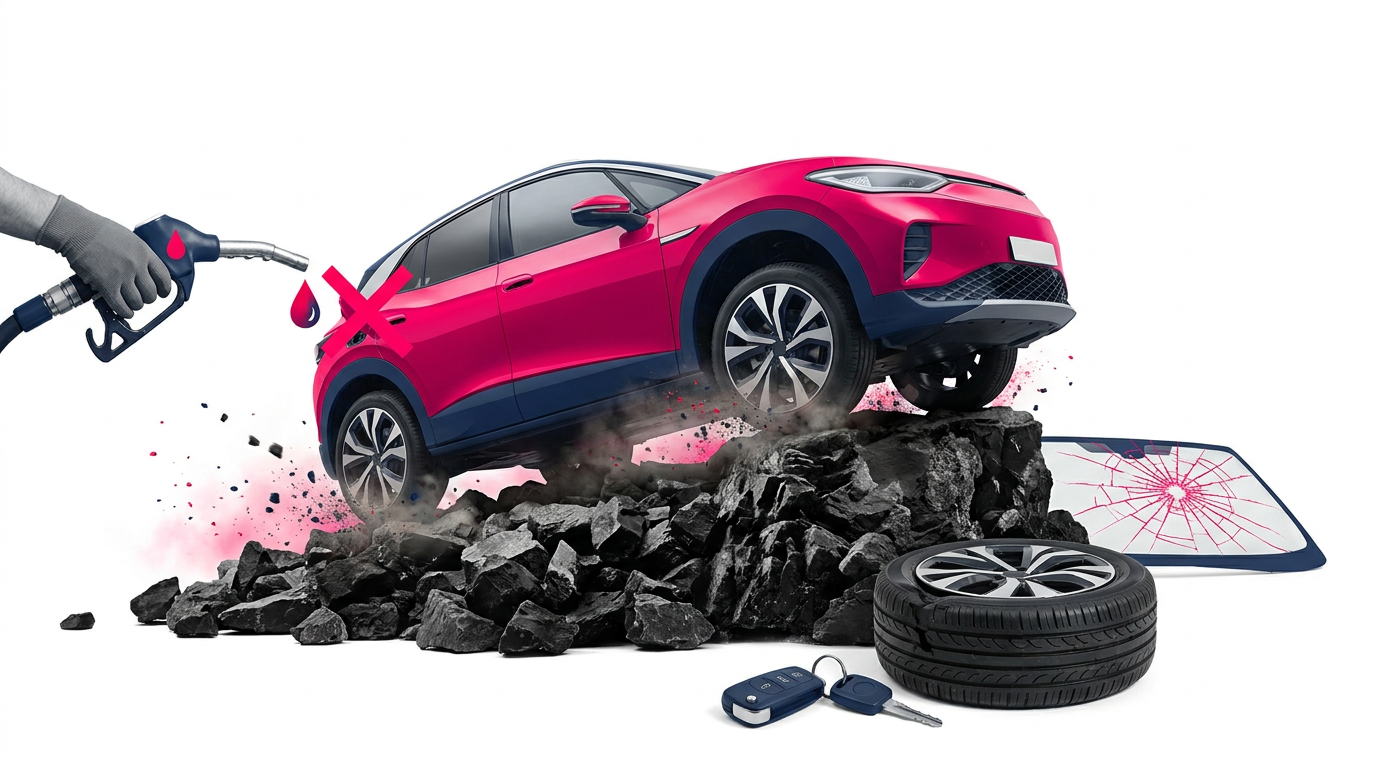
The exclusions determine whether the excess applies. The most common categories to look for in the contract are:
- driving by a person not registered as an additional driver,
- driving under the influence of alcohol or drugs,
- driving on a prohibited or unsuitable road,
- damage from wrong fuel, negligence or a lost key,
- taking the vehicle on a ferry without prior permission,
- late or incomplete reporting of an accident.
In Greece, taking a car on a ferry needs particular attention. If you pick up a car in Athens and want to take it to an island, ask for written permission. There may be an extra charge or a limit on cover during the sea crossing.
For a holiday spent entirely on one island, it’s often simpler to rent the vehicle there. You could, for example, look at available cars for car rental on Naxos instead of bringing a vehicle over from the mainland.
What to do immediately after an accident
Stop safely and contact the provider before agreeing to any repair or towing. Follow the instructions on the police, incident reporting and roadside assistance.
Photograph the vehicles, the number plates, the location and the road conditions. Note the details of the other drivers and any witnesses. Don’t settle for a verbal agreement just because the damage looks minor.
Maria, for example, finds a scratch after parking. If she simply returns the car without saying anything, it becomes harder to document the incident. She should call the number given in the contract, photograph the damage and follow the provider’s procedure.
Rental car insurance without a credit card or deposit
The payment card doesn’t determine the insurance cover by itself. It does, however, affect the deposit process and, in some cases, the options the provider offers.
Some vehicles may be available with a debit card, while others require a credit card in the main driver’s name. There may also be different hold amounts or additional conditions. Check the terms before you pay, not when you arrive for pick-up.
The phrase “no deposit” needs clarifying. It may mean no amount is blocked on your card, but it doesn’t necessarily mean there is no liability for fuel, fines, a lost key or excluded damage.
In our example, Maria only has a debit card. Before choosing the cheapest offer, she confirms in writing that the card is accepted and asks for the hold amount. That way she avoids arriving at the port and discovering she can’t pick up the car.
How cover changes by car and pick-up point
The vehicle category often affects the excess, the deposit and the price of add-on cover. A small city car doesn’t necessarily have the same terms as an SUV, a convertible, a minivan or a luxury model.
If you need more space or four-wheel drive, look at the available options for SUV rental. Check whether choosing a larger vehicle changes the excess. An SUV is not a licence to go off-road.
For electric cars, ask about charging cables, loss of equipment and charges for returning the car with a low battery. The electric car rental page helps you narrow your search to the right category, but the insurance terms remain specific to each available option.
Airport pick-up or door-to-door delivery
At Athens or Thessaloniki airport, check whether pick-up is at a desk, a car park or a meeting point. Also see whether there is an out-of-hours charge and how the car’s initial condition is recorded when it is handed over late at night.
To search near your arrival point, see the options at Athens Airport or in Thessaloniki. The pick-up location doesn’t change how the insurance basically works, but it does affect the inspection and handover process.
If door-to-door delivery has been agreed, ask for time to inspect the car. Don’t sign in a hurry just because the delivery driver is waiting. Take a continuous video of the car and close-up photos of the wheel rims, bumpers, windscreen and roof.
How to compare insurance and total price before you book
Start with the same dates, car category and pick-up point. Then compare the same level of protection. Comparing an offer with a €1,200 excess against one with a €200 excess on the daily rate alone gives the wrong result.
Note down in one file the total rental cost, the damage excess, the theft excess, the deposit and the main exclusions. Add the fuel policy, the mileage allowance and the late-return charges.
Before you pay, ask for clear answers to the following:
- What is the excess for damage, and what is it for theft?
- What amount will be blocked, and on which card?
- Are glass, tyres, mirrors and the underside covered?
- Is taking the car on a ferry or driving on a dirt road allowed?
- What documents are required after an accident?
- How long after the return is the deposit released?
For a last-minute booking, don’t skip these steps just because there are few options available. Save the terms shown at the time of booking and ask for confirmation of anything that remains unclear.
How Sync helps you organise your choice of car and cover
The process on Sync starts with the place and dates you’re interested in. You choose a destination, look at the available cars and narrow down the options based on the needs of your trip. The how Sync works page explains the basic flow of the service.
Next, you look at the specific vehicle, not just the general category. A small model may suit narrow island roads, while a minivan is more practical for a large family. Your choice should fit your passengers, luggage and routes.
Before completing the booking, review the available terms and confirm with the provider everything that affects your liability: basic cover, excess, deposit, accepted card and exclusions. If a term isn’t stated clearly, ask for a written answer.
Finally, you pick up the car according to the agreed procedure and record its condition. The platform can help you find and compare vehicles, but you shouldn’t replace reading the contract with an assumption about what “full insurance” means.
For Maria, this flow means she searches for a car on Naxos, chooses a small model for five days and compares the final cost with a €900, €200 and €0 excess. Because she has a debit card and plans to visit a remote beach, she confirms the deposit payment method and the road restrictions before booking.
FAQ: rental car insurance
Is basic rental car insurance enough?
It depends on the excess and how much financial risk you can tolerate. If the excess is €1,000 and a charge like that would cause you a serious problem, consider cover that reduces it. Check the exclusions first, because a lower excess doesn’t necessarily cover every type of damage.
What does full insurance with no excess mean?
It usually means your liability for certain covered damage is reduced to €0. It doesn’t mean unlimited protection. Breaches of the terms, wrong fuel, a lost key or an unauthorised driver may still be excluded.
Will I pay the full excess for a small scratch?
Not necessarily. The excess usually works as a maximum for covered damage, not as a fixed charge. Ask for documentation of the damage, photos, the return report and a breakdown of the amount you’re being charged.
Does the insurance cover damage to a tyre or the windscreen?
Only if it’s stated in the terms or in an add-on cover. Many basic options exclude tyres, wheel rims, glass and the underside. Also check whether the damage happened on a road where the vehicle was allowed to be driven.
Can I rent a car with a debit card?
You can, when the specific provider and vehicle allow it. Confirm the card type, the cardholder’s name, the deposit amount and whether additional cover is required. Don’t rely on a general rule of the platform or the company.
Do I need extra insurance for an island holiday?
Not necessarily, but the routes and local conditions deserve attention. If you plan to drive near beaches, check the restrictions on dirt roads and the cover for tyres and the underside. Also ask for permission if the vehicle will be taken on a ferry.
What happens if someone else drives the rental car?
A second driver usually has to be registered on the contract and meet the age and driving licence requirements. If an unregistered person drives, the cover may not apply. Add all possible drivers before you leave the pick-up point.
So which cover should I choose?
Choose based on the maximum charge you can take on, not just the lowest daily rate. For a small budget and a high risk tolerance, basic cover may be acceptable. For a family holiday, an expensive vehicle or limited ability to make an unexpected payment, a reduced or zero excess offers a more predictable cost.
Keep the practical rule in mind: find the excess, check the exclusions and confirm the deposit before you book. If these three things are clear, you can compare cars and prices without discovering the real risk at the pick-up desk.